
Fidelia Soriwei, Abuja
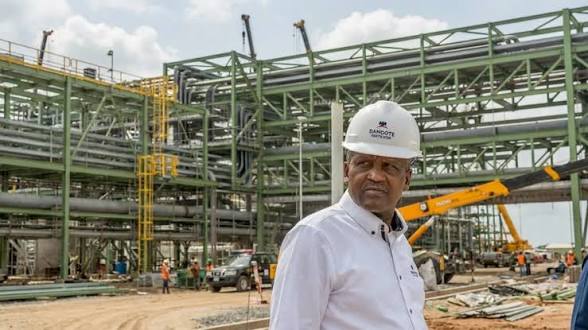
President of the Dangote Group, Aliko Dangote, has disclosed that his company turned down moves by the Nigerian National Petroleum Company Limited (NNPC) to increase its stake in the Dangote Petroleum Refinery beyond the current 7.25 per cent ownership.
Dangote said the decision was taken because the company plans to open the refinery to wider public participation, allowing more Nigerians to own shares in the multi-billion-dollar facility.
Speaking during an interview with the Chief Executive Officer of the Norwegian Sovereign Wealth Fund, Nicolai Tangen, Dangote explained that the refinery’s long-term vision extends beyond institutional ownership.
“The national oil company already owns 7.25 per cent, and they are trying to buy more. We are the ones that said no; we want to now spread it and have everybody be part of it,” he said.
The development comes as domestic petrol supply from the Lekki-based refinery continued to reshape Nigeria’s downstream market, with new industry figures showing a sharp decline in fuel importation during the first quarter of 2026.
Data from the Nigerian Midstream and Downstream Petroleum Regulatory Authority indicated that local refinery supply rose to 3.18 billion litres within the period, while petrol imports dropped to 965.52 million litres.
Industry records show the Dangote refinery remains the only facility currently refining petrol at commercial scale in Nigeria.
Dangote also revealed that the refinery recently processed crude at 661,000 barrels per day, exceeding its official 650,000bpd installed capacity.
“The refinery has been tested. We have now processed even crude at 661,000 barrels a day,” he stated.
He added that increased global energy demand triggered by the United States-Iran crisis had boosted exports and revenue from the group’s refinery, fertiliser and petrochemical businesses.
According to him, fertiliser prices rose from about $400 to $850 per tonne, while polypropylene prices climbed significantly amid supply shortages in global markets.
The billionaire businessman further disclosed that the group plans to attract more investors into its operations as part of a broader expansion strategy targeted at achieving $100 billion in revenue by 2030.
Dangote also reflected on the financial hurdles encountered during the refinery’s construction, noting that the project eventually relied heavily on support from African and Nigerian financial institutions following naira devaluation.
He said the company received funding support from Afreximbank, the Africa Finance Corporation, Zenith Bank, Access Bank, UBA, Standard Bank South Africa, and Standard Chartered Bank UK.
The industrialist equally spoke about personal sacrifices made while building the refinery, revealing that he sold properties in the United States and the United Kingdom to concentrate fully on the project in Nigeria.
“When I decided to go into the industry, I sold all my properties in the US and the UK because I wanted to sit in Nigeria and concentrate,” he said.
Dangote maintained that his business philosophy remains focused on producing goods Nigerians heavily depend on rather than relying on imports.
He also accused entrenched interests benefiting from fuel importation and subsidy regimes of attempting to frustrate the refinery project.
“These are the people that did not want us to settle down because they believed that we were coming here to displace them, and of course, that’s what we have done now,” he added.