

By Tom Zaneni
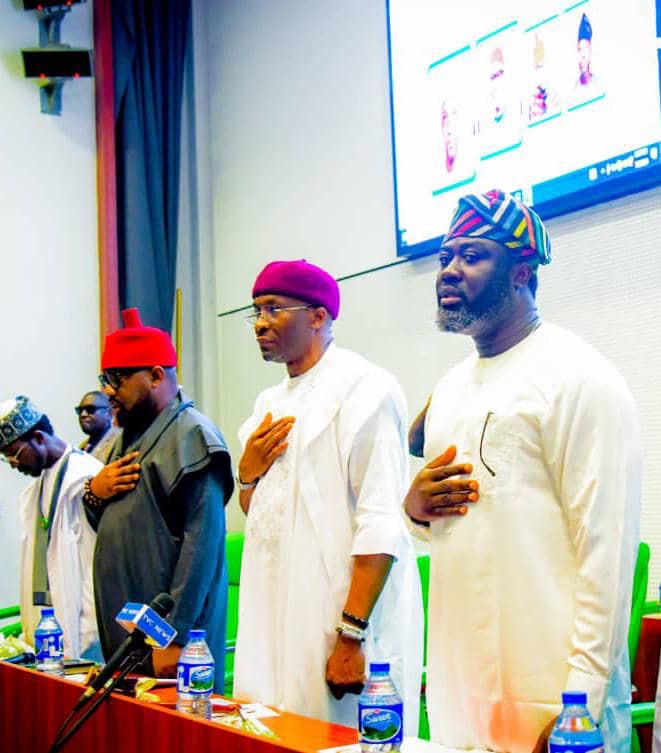
Deputy Speaker of the House of Representatives Rt Hon Benjamin Kalu (m) and Chairman House Committee on Petroleum Resources Downstream, Hon Ikenga Ugochinyere (l) and Chairman House Committee on Petroleum Resources Midstream Hon Henry Okojie (r) at the inaugural meeting of the House Joint Midstream and Downstream Committee Investigating Challenging Developments in the Downstream, Midstream Sector, July 22, 2024
Nigeria’s House of Representatives, on Monday, launched an investigation into allegations of the importation of adulterated petroleum products into the country.
The House, through its Joint Petroleum Committee on Midstream and Downstream Sectors, will also probe the scarcity of crude oil for refining by refineries.
The green chamber had constituted the joint committee on July 9 to carry out a forensic investigation aimed at uncovering adulterated imported petroleum products and the lack of crude oil for use by refineries.
Speaking at the committee’s inaugural meeting on Monday, the House of Representatives Speaker, Tajudeen Abbas, expressed concern over the resurgence of fuel queues at petrol stations across the country.
He also frowned at the rising cost of petrol and the inexplicable shortage of crude oil feedstock for domestic refineries.
Abbas, who was represented by the deputy speaker of the House, Benjamin Kalu, stressed the urgent need to scrutinize the quality of petroleum products imported into the country.
He called on relevant stakeholders to ensure compliance with global standards.
Specifically, Abbas urged the Nigerian Midstream and Downstream Petroleum Regulatory Authority (NMDPRA), the Standards Organization of Nigeria (SON) and others to ensure that all imported petroleum products are subjected to rigorous laboratory testing to ascertain the sulphur and octane levels in them.
He expressed strong disapproval over the quality of petrol being imported into the country, pointing out its high sulphur content, lead presence and low octane levels.
He said, “In carbon-conscious economies, maintaining high octane levels is a crucial regulatory concern for both energy regulators and environmental protection agencies. While lower octane levels reduce refining costs, this should not compromise quality and environmental standards.
“Regulatory bodies such as the Standards Organization of Nigeria (SON), the National Environmental Standards and Regulations Enforcement Agency (NESREA), and the Nigerian Midstream and Downstream Petroleum Regulatory Authority (NMDPRA) play a vital role in ensuring that the petrol consumed in Nigeria meets environmentally-friendly standards.
“In addressing the challenges faced by domestic refiners in securing reliable crude oil feedstock, it is important to emphasize that President Bola Ahmed Tinubu is dedicated to creating a level-playing field for both producers and refiners in the industry.”
The speaker added that the rules of engagement should be structured in a way that the pricing models from oil producers are not to the disadvantage of domestic refineries.
“Additionally, I call on the Joint Petroleum Committee on Midstream and Downstream Sectors to work towards aligning the Domestic Crude Oil Supply Obligation with the nation’s energy security.
“This collaboration with sector regulators is crucial for re-engineering regulatory processes to effectively tackle these challenges”, he stated.
He applauded the chairmen of the committees, Ikenga Ugochinyere and Henry Okojie for their efforts and urged them to “work with a shared sense of purpose and determination to ensure that Nigeria’s energy sector operates at the highest standards of quality, efficiency, and environmental sustainability.”
In his remarks, Ugochinyere appealed to all stakeholders to provide total support, including essential information and documentation.
He urged refinery operators, importers, producers, and marketers of petroleum products to share their complaints, suggestions, and independent insights to aid the exercise.
The federal legislator also noted that the investigation was targeted at “identifying and resolving the underlying issues plaguing Nigeria’s petroleum sector.”
He, therefore, urged all relevant stakeholders to refrain from attacks in the media space until the inquiry is concluded.

