

By Attah Ede
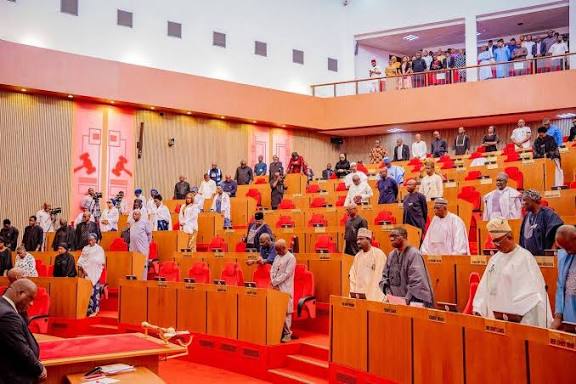
The Senate on Tuesday passed the Electoral Act, 2022 (Repeal and Re-Enactment) Bill 2026 despite public outcry and protest by some group of Nigerians.
Before the passage, there was a rowdy session as the upper chamber resumed proceedings with a demand for division over Clause 60 raised by Senator Enyinnaya Abaribe (ADC/Abia South).
The Senate President, Godswill Akpabio, informed that he believed the demand had previously been withdrawn, but several opposition senators immediately objected to that claim.
Citing Order 52(6), the Deputy Senate President, Barau Jibrin, argued that it would be out of order to revisit any provision on which the Senate President had already ruled.
This development triggered another uproar in the chamber, resulting to Senator Sunday Karimi and Abaribe engaging in serious exchanges.
The Senate Leader, Opeyemi Bamidele, then reminded lawmakers that he had sponsored the motion for rescission, underscoring that decisions previously taken by the Senate are no longer valid.
Akpabio further suggested that the call for division was merely an attempt by Senator Abaribe to publicly demonstrate his stance to Nigerians.
The senate president sustained the point of order, after which Abaribe rose in protest and was urged to formally move his motion.
Rising under Order 72(1), Abaribe called for a division on Clause 60(3), specifically concerning the provision that if electronic transmission of results fails, Form EC8A should not serve as the sole basis.
He advocated for the removal of the provision that allows for manual transmission of results in the event of network failure.
During the division, Akpabio directed senators who supported the caveat to stand.
He then asked those opposed to the caveat to rise.
Consequently, 15 opposition senators stood against.
However, when the votes were counted, the Senate President announced that 15 senators were not in support of the provision, while 55 senators voted in support of it.
The bill was therefore passed into law

