

From Attah Ede, Makurdi
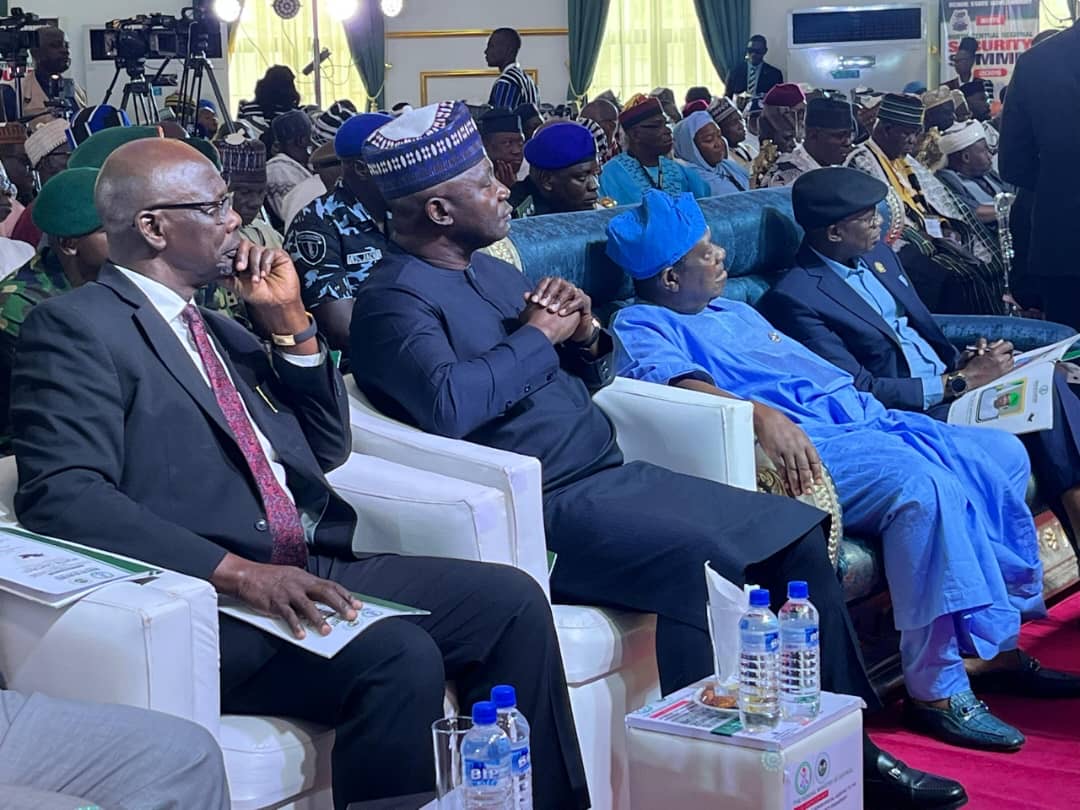
President Bola Ahmed Tinubu has enjoined traditional and religious leaders, communities, youths, women, development partners, and the private sector in the North-Central to strengthen collaboration with government and security agencies towards ending insecurity and building lasting peace in the region.
The President gave the charge on Monday while speaking at the 2026 North-Central Regional Security Summit held in Makurdi, Benue State.
He was represented at the occasion by the Secretary to the Government of the Federation (SGF), Senator George Akume.
President Tinubu particularly called on traditional and religious leaders to serve as the first line of early warning and trusted voices of reconciliation in their communities.
He urged citizens to share intelligence with security agencies and refuse to shield criminals on the basis of kinship or sentiment.
He said women and youths must take their rightful place in peacebuilding efforts, while urging development partners and the private sector to see the North-Central not merely as a region requiring assistance, but as an investment destination with enormous economic potential.
The President said the theme of the summit, “Collaborative Approaches to Strengthening Security and Regional Stability,” was apt, noting that no single security agency, tier of government, or community could effectively secure the region while acting in isolation.
He noted that insecurity transcends state boundaries and institutional mandates, requiring security agencies and communities to overcome rivalry, duplication of efforts, and the withholding of vital information.
He said: “No single agency, no single tier of government and no single community can secure this region acting alone. Insecurity does not respect state boundaries or agency mandates. Criminals move freely across local government areas while our responses are too often slowed by rivalry, duplication and the withholding of information. That must end.”
President Tinubu said his administration had deliberately strengthened the nation’s security architecture through enhanced collaboration among the Armed Forces, the Nigeria Police Force, and intelligence services, as well as the acquisition of new platforms and advanced capabilities for the military.
He added that the administration was rebuilding Nigeria’s indigenous defence industry through the Defence Industries Corporation of Nigeria (DICON) Act, while improving the welfare of troops to enhance their operational effectiveness.
Tinubu commended the Armed Forces and other security agencies for the gains recorded against terrorists and other criminal elements.
He noted that terrorist commanders had been neutralised, with thousands of fighters surrendering.
He added that captives had been rescued, and normalcy restored to several communities.
He paid tribute to servicemen and women, police officers, and other security personnel operating in the North-Central, particularly those who had paid the supreme price in defence of the country.
President Tinubu, however, cautioned that military action alone would not guarantee sustainable peace in the region, stressing the need to address the underlying social, economic, and environmental factors fuelling insecurity.
He identified competition over land and water, climate change, desertification, unresolved land-use issues, weak local dispute-resolution mechanisms, and the proliferation of illicit weapons as some of the conditions sustaining violent conflicts.
“Military action alone will not deliver lasting peace to the North Central. Force can suppress violence; it cannot resolve the grievances that produce it,” he said.
The President said the Federal Government’s response would, therefore, continue to combine kinetic operations with developmental interventions.
He cited the Federal Government’s efforts through the Ministry of Livestock Development to transition from open grazing to modern, settled livestock production as part of measures to protect farmlands, improve pastoral livelihoods, and remove a major trigger of conflict.
He also highlighted the Reclaiming the Ungoverned Space for Economic Benefits Programme of the Ministry of Defence, which is designed to deploy the experience of retired military personnel towards securing and reviving communities recovering from violence.
President Tinubu similarly called on communities to take greater responsibility for their security by providing timely information to security agencies and refusing to harbour criminal elements.
“Security begins with you. I call on every citizen to share information with the security agencies, to refuse to shield criminality out of kinship or sentiment, and to resist those who would recruit our sons into violence for a handful of naira,” he said.
The President who declared the 2026 North-Central Regional Security Summit open, commended the government and people of Benue State for hosting the summit, and praised the resilience of the people of the North-Central in the face of security challenges.
Earlier, the Minister of Defence, General Christopher Musa, said the summit was organised to hear from the people of the region about the real threats on the ground and find common ground to address the challenges.
While noting that everyone was interested in security in the region, Musa commended the people for not giving up on themselves.
He stressed the need to prevent cattle from grazing on farmlands, saying collective efforts should be made to ensure farmers are safe in their communities and on their farms while also ensuring that livestock production thrives without friction.
He pledged that the Federal Government remained committed to improving security across the nation and tackling challenges that undermine it.
Welcoming participants to the North-Central Zonal Security Summit, Benue State Governor, Rev. Fr. Hyacinth Alia, noted that the focus on banditry, farmer-herder conflicts, kidnapping, violent extremism spillover, organised crime, and community resilience spoke directly to the realities confronting communities across the North-Central region.
According to him, Benue State, and indeed other parts of the North-Central, face unique security challenges that require a collaborative security strategy.
“It is my considered position that our diversity should be a source of strength rather than weakness. What are those things that unite us, and what are those things that divide us and breed insecurity?” he asked.
Alia called for stakeholders to set aside their differences and confront the challenge of insecurity, saying that if this was done, half the battle would already be won.
The governor commended the Ministry of Defence and the Office of the Senior Special Assistant to the President on Community Engagement, North-Central, for organising the summit, describing it as an important effort towards localising security responses.
He said security could not be left entirely to soldiers carrying rifles but must involve intelligence sharing, border-community engagement, and efforts to address poverty and idleness.
The governor urged participants to ensure that the summit produced concrete outcomes capable of strengthening the security architecture of the North-Central for years to come.
The summit also featured presentations by state governors and their representatives, experts, and retired security personnel.

