

Fidelia Soriwei, Abuja
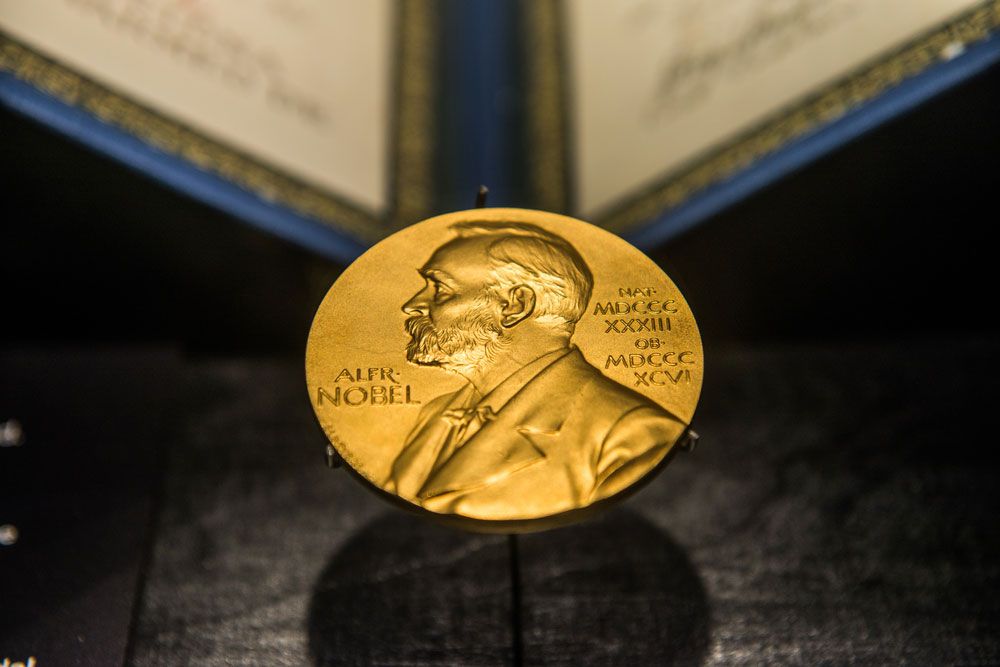
The 2026 Nobel Prize announcements have concluded, with six categories recognising contributions to medicine, physics, chemistry, literature, peace and economic sciences.
The announcements began on October 5 with the Nobel Prize in Physiology or Medicine and ended on Monday, October 12, with the economics prize.
The awards are rooted in the will of Swedish inventor and industrialist Alfred Nobel, who directed that his fortune be used to recognise contributions benefiting humanity. The economics prize was established separately by Sweden’s central bank and first awarded in 1969.
Here is the full list of the 2026 laureates, their achievements and professional backgrounds, according to information published by the Nobel Prize organisers.
1. Physiology or Medicine: Karl Deisseroth, Peter Hegemann and Georg Nagel
American scientist Karl Deisseroth and German scientists Peter Hegemann and Georg Nagel received the prize for discoveries concerning light-gated ion channels and optogenetics.
Their work helped establish optogenetics, a technique that uses light to control nerve-cell activity. The method has transformed neuroscience by allowing researchers to investigate how specific brain cells influence memory, emotions and behaviour, as well as study neurological and psychiatric conditions.
Hegemann and Nagel discovered a light-sensitive protein in algae, while Deisseroth helped develop the discovery into a practical technique for controlling nerve cells.
Deisseroth, born in 1971, is a neuroscientist and psychiatrist at Stanford University, where he is the D.H. Chen Professor of Bioengineering and Psychiatry and Behavioral Sciences. He earned his MD and PhD from the university.
Hegemann, born in 1954, is Hertie Senior Professor of Neuroscience at Humboldt University of Berlin. Nagel, born in 1953, is a professor of molecular plant physiology at the University of Würzburg. Both are German scientists whose research contributed to the development of optogenetics.
2. Physics: Francis Halzen
Belgian-American physicist Francis Halzen won the physics prize for his decisive contributions to the IceCube Neutrino Observatory and the discovery of high-energy neutrinos originating from astrophysical sources.
Neutrinos are elusive particles that can travel through matter with minimal interaction. Detecting them allows scientists to investigate some of the universe’s most energetic phenomena, including events associated with distant galaxies and black holes.
Halzen’s work helped establish IceCube, a large detector embedded in Antarctic ice near the South Pole. The observatory uses thousands of sensors to identify faint flashes of light produced when neutrinos interact with matter.
Born in Belgium in 1944, Halzen studied at the Catholic University of Leuven, now KU Leuven, where he obtained his master’s and doctoral degrees. He joined the University of Wisconsin-Madison’s physics faculty in 1972 and became a leading figure in neutrino astronomy, serving as principal investigator of the IceCube observatory.
3. Chemistry: Henri B. Kagan and Kenso Soai
French chemist Henri B. Kagan and Japanese chemist Kenso Soai received the chemistry prize for discoveries concerning asymmetric organic synthesis and chemical reactions that favour one of two mirror-image forms of a molecule.
Although mirror-image molecules may be chemically similar, they can behave differently in biological systems. Controlling their formation is therefore important in producing medicines and other biologically active compounds.
Kagan’s research advanced asymmetric catalysis, which enables chemical reactions to favour a particular molecular form. Soai demonstrated asymmetric autocatalysis, in which a reaction’s product helps catalyse the production of more of the same form. His discovery became known as the Soai reaction.
Kagan is a French chemist associated with Université Paris-Sud, now part of Université Paris-Saclay, and is recognised for his work in stereochemistry and asymmetric catalysis.
Soai, born in Hiroshima Prefecture, Japan, in 1950, graduated from the University of Tokyo and earned a Doctor of Science degree. He conducted his pioneering research at Tokyo University of Science, where he is now a professor emeritus.
4. Literature: Anne Carson
Canadian poet, essayist, classicist and translator Anne Carson won the literature prize for her distinctive body of work, which draws on classical traditions while creating new forms of contemporary writing.
The Swedish Academy honoured Carson “for her bold and inventive oeuvre that, in playful dialogue with the classical tradition, has created new forms for contemporary literature”.
Her writing frequently connects ancient Greek literature and ideas with modern experiences. Her work spans poetry, prose, translation and scholarship, making it difficult to classify within a single literary genre.
Born on June 21, 1950, in Toronto, Carson earned bachelor’s and master’s degrees from the University of Toronto in 1974 and 1975, respectively, before completing her PhD there in 1981.
Her notable works include Eros the Bittersweet, Autobiography of Red and If Not, Winter: Fragments of Sappho. Her honours include a MacArthur Fellowship, Guggenheim Fellowships and Spain’s Princess of Asturias Award for Literature. She was appointed a Member of the Order of Canada in 2005.
5. Peace: Navanethem ‘Navi’ Pillay
South African jurist and former United Nations High Commissioner for Human Rights Navanethem “Navi” Pillay received the Nobel Peace Prize for her work promoting peace and international law.
The Norwegian Nobel Committee recognised her contributions to advancing an international legal order and supporting efforts to ensure that war crimes, crimes against humanity and genocide can be prosecuted.
Born in Durban in 1941 to a family of Indian Tamil descent, Pillay became a lawyer during apartheid and established her own law firm in 1967. She earned a Doctor of Juridical Science degree from Harvard University in 1988 and became a judge of South Africa’s High Court in 1995.
In 1999, she became a judge and president of the International Criminal Tribunal for Rwanda. She later served as a judge of the International Criminal Court and as UN High Commissioner for Human Rights from 2008 to 2014.
Pillay also chaired the UN Independent International Commission of Inquiry on the Occupied Palestinian Territory from 2021 to 2025.
6. Economic Sciences: Robert E. Hall and Michael Woodford
American economists Robert E. Hall and Michael Woodford won the 2026 Sveriges Riksbank Prize in Economic Sciences in Memory of Alfred Nobel for their work on “microeconomic foundations of macroeconomic stabilisation”.
The Royal Swedish Academy of Sciences announced the award on Monday, completing this year’s Nobel Prize announcements.
Their research developed macroeconomic models that improve understanding of how governments and central banks can stabilise economies during recessions and periods of rapid growth. The work examines how households’ and businesses’ decisions about spending, saving and prices, alongside their expectations of future policies, influence economic outcomes.
Hall, born in 1943 in Palo Alto, California, earned his PhD from the Massachusetts Institute of Technology in 1967. He is a Stanford University professor known for research on macroeconomics, economic fluctuations and consumer behaviour.
Woodford, born in 1955 in Chicopee, Massachusetts, obtained his PhD from the Massachusetts Institute of Technology in 1983. He is a professor at Columbia University in New York and is known for his work on monetary policy, economic expectations and macroeconomic theory.
Unlike the five original Nobel Prize categories, the economics prize was established by Sweden’s central bank in memory of Alfred Nobel and first awarded in 1969.
When will the 2026 Nobel Prizes be presented?
The laureates are traditionally presented with their medals and diplomas on December 10, the anniversary of Alfred Nobel’s death.
The Peace Prize ceremony takes place in Oslo, Norway, while the ceremonies for the other prizes are held in Stockholm, Sweden.

